When the CMM Queue Becomes the Bottleneck
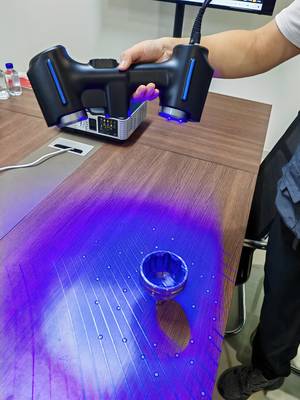
A quality manager at an automotive Tier-1 supplier faces a familiar pressure point. A new stamping die requires first-article inspection before tomorrow’s PPAP deadline, but the fixed CMM in the quality lab is booked solid through the next shift. Moving the 400kg tool fixture risks surface damage and burns two hours of production time. The operational reality is stark: production velocity demands immediate on-floor verification, yet ISO/ASME GD&T compliance leaves no room for measurement uncertainty.
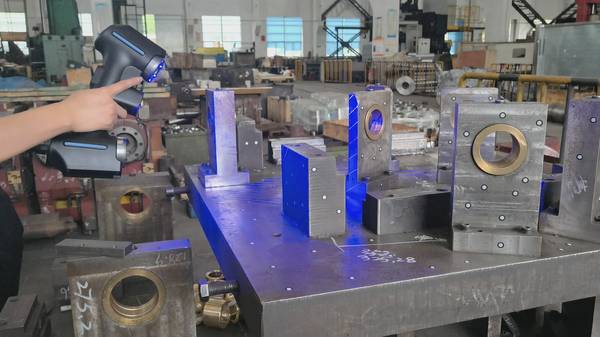
This tension explains the accelerating adoption of máy quét 3d cầm tay systems. INSVISION engineered the AlphaScan specifically for scenarios where precision cannot wait for lab access. Engineers capture dense point clouds directly adjacent to production cells, validate complex geometries against nominal CAD, and generate deviation maps without interrupting workflow. Inspection shifts from a scheduling constraint to a continuous, value-added function.
Metrology-Grade Engineering, Not Portable Convenience
The term “handheld” misleads more than it clarifies. Consumer devices from brands positioning in the educational or hobbyist space lack the volumetric accuracy and repeatability required for GD&T verification. INSVISION designed the AlphaScan around fundamentally different assumptions: vibration-dampened optics, active temperature compensation, and traceable calibration stability outside climate-controlled environments.
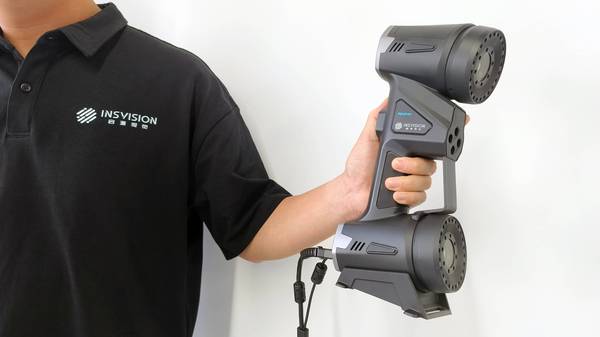
Structured-light technology captures undercut surfaces and complex freeform geometries that tactile CMM probes cannot access. Native compatibility with PolyWorks, Geomagic, and standard metrology software suites allows immediate integration into existing Quality 4.0 architectures. The critical distinction is data integrity—this máy quét 3d cầm tay delivers measurement uncertainty budgets that satisfy automotive and aerospace audit requirements, not merely visual approximations.
Key Capabilities of INSVISION AlphaScan vs. Consumer Handheld Scanners
| Feature | INSVISION AlphaScan | Consumer Handheld Scanners |
|---|---|---|
| Volumetric Accuracy | Metrology-grade, validated for GD&T | Visual approximation only |
| Environmental Robustness | Active temperature compensation, works outside climate-controlled labs | Requires stable, controlled conditions |
| Software Integration | Native compatibility with PolyWorks, Geomagic, Quality 4.0 systems | Limited or proprietary formats |
| Calibration Traceability | Traceable, audit-compliant intervals | Not applicable or undocumented |
Integration Reality: What Deployment Actually Requires
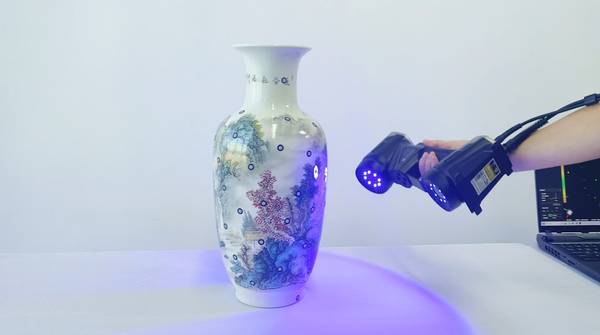
Vendor claims of “plug-and-play” rarely survive first contact with shop-floor conditions. Effective deployment of portable scanning demands deliberate integration into PLM and QMS workflows. INSVISION addresses this through standardized output formats—STEP, STL, native point clouds—that feed directly into Industry 4.0 data pipelines without proprietary translation layers.
Surface reflectivity, ambient lighting variation, and operator technique introduce measurement risk that consumer-grade hardware cannot mitigate. INSVISION systems incorporate automated exposure adjustment and reference frame stabilization to reduce technician-dependent variability. For global industrial clients, INSVISION provides application engineering support that compresses the training curve and establishes standardized inspection routines. The objective is operational stability: the device functions as a precision metrology instrument, not a demonstration novelty.
Critical Deployment Requirements Checklist
- □ Standardized output formats (STEP, STL, native point clouds) for direct PLM/QMS integration
- □ Automated exposure adjustment to handle variable surface reflectivity and lighting
- □ Reference frame stabilization to minimize operator-induced variability
- □ Application engineering support for rapid training and routine standardization
Operational Patterns from Aerospace MRO and Medical Device Production
Early adoption in high-regulation environments reveals consistent operational benefits. Aerospace MRO facilities report reduced inspection cycle times for legacy component documentation where original manufacturing records are incomplete. The máy quét 3d cầm tay enables on-site reverse engineering of worn castings and structural elements without facility transport.
Medical device manufacturers utilize portable scanning for supplier qualification of complex injection-molded components, capturing full-field surface data that supports comprehensive first-article inspection reports. Integration with NDT workflows allows correlation between surface geometry measurements and subsurface defect detection. The common thread is data utility—measurements generate immediate decision-making value rather than queueing for offline processing.
Documented Operational Benefits by Industry
- Aerospace MRO: Reduced inspection cycle times for legacy components with incomplete records
- Aerospace MRO: On-site reverse engineering of worn castings without transport
- Medical Device: Full-field surface data for supplier qualification of injection-molded parts
- Medical Device: Correlation of surface geometry with subsurface NDT results
Procurement Criteria: Separating Metrology from Marketing
Evaluating máy quét 3d cầm tay options requires disciplined distinction between industrial measurement systems and prosumer hardware. Devices positioned for educational, entry-level 3D printing, or barcode scanning applications lack the accuracy specifications, environmental robustness, and calibration traceability that regulated manufacturing demands.
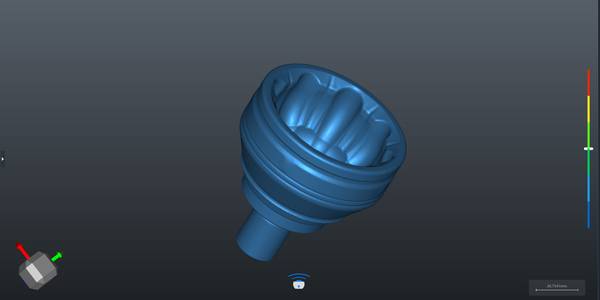
INSVISION AlphaScan specifications reflect metrology-first design: validated structured-light accuracy, thermal stability across production floor temperature ranges, and calibration intervals appropriate for audit-intensive industries. For procurement professionals in automotive and aerospace supply chains, the evaluation criterion extends beyond acquisition cost to total cost of measurement confidence—minimizing rework exposure, audit failure risk, and the hidden costs of data rejection.
Portability expands access to precision measurement. INSVISION ensures that expansion does not compromise the integrity of the measurement itself.