The Hidden Cost of Unreliable Scan Data on the Shop Floor
A first-article inspection fails because a black rubber seal against polished aluminum won’t register. The technician reaches for developer spray, loses twenty minutes to surface prep, and still watches the alignment drift under standard fluorescent lighting. This isn’t a hypothetical edge case—it’s Tuesday morning in automotive and aerospace supply chains where a reliable 3D scanner means the difference between on-time delivery and costly delays.
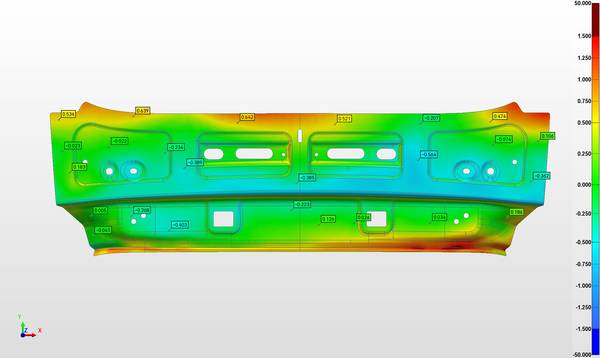
Field reports from Einscan HX users document consistent struggles with dark surfaces without aerosol treatment. Artec Eva operators note alignment degradation under typical shop lighting conditions. The Creaform HandySCAN demands recalibration after temperature shifts that are inevitable near stamping presses or heat-treat stations. Each workaround burns hours that lean manufacturing cannot absorb.
INSVISION designed its hardware for these conditions specifically. No rescanning featureless cylinders because auto-alignment quit. No afternoons lost to mesh cleanup. One scan, one pass, documented confidence.
Why Surface Sensitivity and Environmental Drift Undermine Metrology Confidence
At a Tier-1 automotive stamping line, a technician spent twenty minutes spraying developer on a glossy transmission housing for baseline capture. The 3D scanner’s spec sheet promised high accuracy—fine print assuming 20°C labs with controlled lighting. Reality delivers chrome finishes, black molded rubber, and thermal gradients that spike noise and demand heavy post-processing.
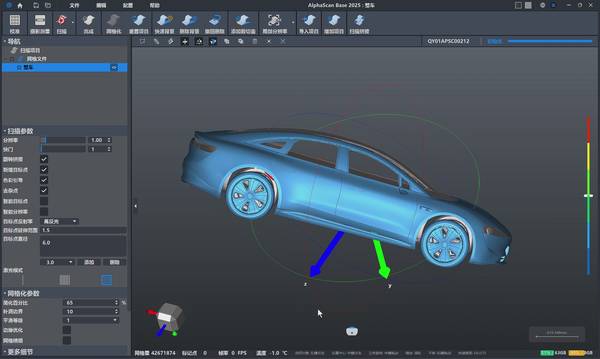
Thermal drift compounds the problem. Field units from multiple manufacturers require recalibration mid-shift when plant temperatures rise or operators move near heat sources. This instability corrupts GD&T report confidence. The workaround—adapting the environment to the tool—defeats the purpose of portable metrology.
INSVISION addresses this through integrated thermal compensation and surface-adaptive capture. The data holds when floor conditions don’t.
Common Scanner Limitations in Industrial Environments
| Scanner Model | Documented Limitation |
|---|---|
| Einscan HX | Struggles with dark surfaces without aerosol treatment |
| Artec Eva | Alignment degrades under typical shop lighting |
| Creaform HandySCAN | Requires recalibration after minor temperature shifts near industrial equipment |
INSVISION AlphaScan: Handheld Reliability Without the Compromises
Previous workflows for glossy black automotive trim meant developer spray and hoping alignment survived the scan. The INSVISION AlphaScan 3D scanner eliminates that contingency. Matte, glossy, and dark surfaces capture natively—no surface preparation, no throughput penalty.
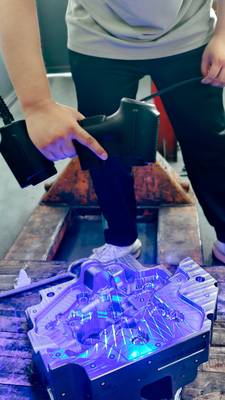
Movement from climate-controlled metrology labs to active production lines does not trigger calibration drift, a documented failure mode for competing handheld units. Structured-light architecture delivers metrology-grade repeatability for ISO/ASME-compliant reporting. The device bridges portable convenience and fixed-CMM reliability without requiring either environment to accommodate its limitations.
Workflow Advantages of INSVISION AlphaScan vs. Competing Handheld Scanners
| INSVISION AlphaScan | Competing Handheld Scanners |
|---|---|
| Natively captures matte, glossy, and dark surfaces without developer spray | Require surface preparation (e.g., developer spray) for non-ideal surfaces |
| No calibration drift when moving between lab and production environments | Require recalibration due to thermal shifts near industrial equipment |
| Outputs alignment-stable point clouds convertible directly to STEP/IGES | Produce raw meshes requiring manual repair before CAD integration |
Eliminating Post-Processing Bottlenecks
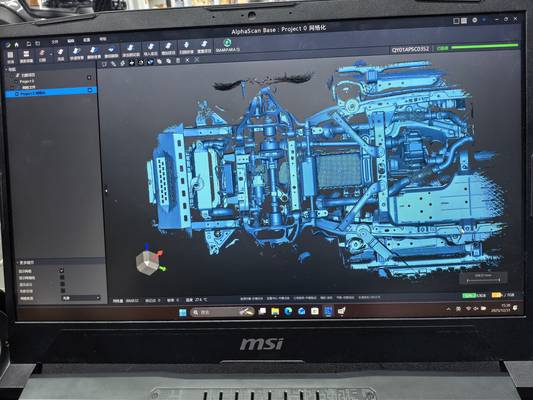
The actual bottleneck in most workflows isn’t data capture—it’s the reconstruction phase. Raw meshes resembling Swiss cheese force manual surface rebuilding in third-party software before design work can begin. Proprietary file formats add translation friction that stalls projects.
INSVISION AlphaScan outputs alignment-stable point clouds that convert directly to STEP and IGES. No expensive add-ons to interface with SOLIDWORKS or Siemens NX. The data arrives parametric-ready, bypassing the “repair and patch” phase entirely. For QC engineers running first-article inspections or reverse engineering legacy components, this eliminates a documented source of cycle-time variance.
Key Workflow Improvements with INSVISION AlphaScan
- □ Eliminates surface preparation for dark, glossy, or matte parts
- □ Maintains calibration stability across thermal shifts in production environments
- □ Outputs native STEP/IGES files compatible with major CAD platforms without add-ons
- □ Delivers parametric-ready data, removing mesh repair steps
From Bottleneck to Predictable Throughput
At a Tier-1 supplier’s stamping line, inspection uncertainty converts directly to schedule slippage. 3D scanner alignment failures on dark or reflective parts force repeated rescans while production queues build. Post-processing noise cleanup extends the delay.
Consistent capture out of the box enables streamlined reporting and faster decision loops. INSVISION closes the gap between metrology-grade accuracy and practical shop-floor deployment with a 3D scanner built for real industrial conditions. For mid-sized industrial teams, this translates to inspection cycles that support workflow rather than constrain it—technology as infrastructure, not interruption.